

How ACAS Early Conciliation helps hospitality employers resolve disputes early, reduce legal costs and make informed commercial decisions
The email arrives from ACAS and your heart sinks.
A current or former employee has contacted them, and your mind immediately jumps to employment tribunals, legal costs and months of disruption.
But before you panic, it’s important to understand what that email actually means.
In most cases, it doesn’t mean a tribunal claim has been lodged. It means ACAS is offering both parties the opportunity to resolve the dispute through Early Conciliation before matters escalate further.
For hospitality employers, where time, money and management focus are already stretched, Early Conciliation can be a practical way to resolve disputes and avoid the stress of a tribunal hearing.
What Is ACAS Early Conciliation?
ACAS Early Conciliation is a free service designed to help employers and employees resolve workplace disputes before they reach an Employment Tribunal.
An independent ACAS conciliator acts as a neutral go-between, helping both parties explore whether a settlement can be reached.
The conciliator does not take sides, provide legal advice or decide who is right or wrong. Their role is simply to facilitate discussions and help both parties find a way forward.
If an agreement is reached, it is recorded in a legally binding document called a COT3 agreement.
Can Employers Contact ACAS First?
Most employers assume that Early Conciliation starts when an employee contacts ACAS.
However, that’s not always the case.
Where a workplace dispute is developing and there is a risk of a future claim, employers can approach ACAS themselves through employer-led Early Conciliation.
This can be particularly useful where both parties may be open to resolving matters before positions become entrenched.
Of course, these situations need careful handling and it’s important to take advice before entering into protected conversations. However, it can be an effective way of resolving disputes before they become more costly and time-consuming.
How Does a COT3 Agreement Differ from a Settlement Agreement?
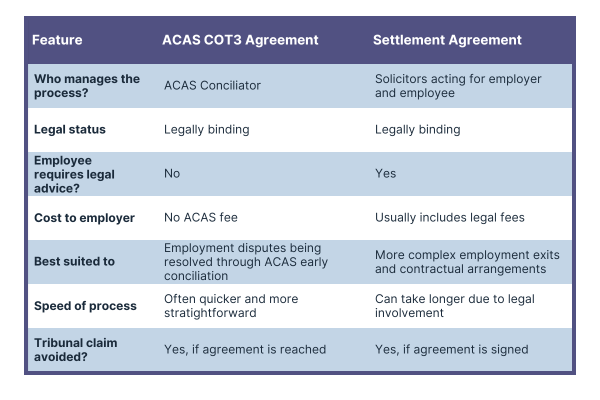
Both approaches have their place. The right option will depend on the circumstances of the case.
When Early Conciliation Makes Sense
Not every dispute should be settled, but there are situations where Early Conciliation can be a sensible commercial decision.
For example:
- A dismissal procedure wasn’t followed correctly.
- A redundancy consultation process was flawed.
- Documentation is incomplete.
- A manager made procedural errors.
- There is a realistic possibility that the business may lose at tribunal.
In these situations, resolving the matter early can save considerable management time, legal costs and uncertainty.
Importantly, reaching a settlement does not mean admitting liability. It simply means both parties have agreed to resolve the dispute without taking it further.
When It May Not Be the Right Option
There are situations where Early Conciliation may not be appropriate.
For example, where an employee has complex contractual arrangements such as long-term incentive schemes, shareholdings, bonus arrangements or detailed service agreements, a traditional
Settlement Agreement is often more suitable.
Similarly, if you have followed a fair process, have strong evidence and genuinely believe a claim has no merit, you may decide that defending the matter is the right course of action.
Every situation should be assessed on its own facts.
Three Questions to Ask Before Making a Decision
1. Did We Follow a Fair Procedure?
Many tribunal claims are won or lost because of procedural mistakes rather than the underlying issue itself.
Take an honest look at what happened and whether your processes were followed correctly.
2. What Is the Real Level of Risk?
Try to step back from the emotions involved.
The important question isn’t whether you agree with the employee’s position. It’s whether an Employment Tribunal might.
An objective assessment of risk is essential.
3. What Will This Cost the Business?
It’s easy to focus solely on the value of a potential settlement.
However, defending a claim can involve significant management time, legal costs and operational disruption.
Sometimes the most commercially sensible option is to resolve the matter early and move on.
Don’t Panic When the ACAS Email Arrives
One of the biggest misconceptions employers have is that an ACAS notification automatically means they are heading for a tribunal.
It doesn’t.
In many cases, it is simply an opportunity to have a conversation and explore whether a dispute can be resolved before it reaches that stage.
Understanding your options early can make a significant difference to the outcome.
Need Advice on an ACAS Claim or Workplace Dispute?
If you’ve received an ACAS notification, or you’re concerned a workplace dispute could develop into a claim, don’t wait until positions become entrenched.
Book a discovery call with Frances Gillespie.
With more than 20 years of hospitality HR experience, Frances helps hospitality employers assess risk, navigate employee relations issues and find practical solutions that protect both the business and its people.
One conversation could save months of stress, significant legal costs and help you move forward with confidence.